
Zimbabwe’s drug crisis has moved from the streets into Parliament. The Thematic Committee on Drugs and Substance Abuse is holding hearings this week into two connected problems: the unregulated sale of cannabis-infused sweets known as mbanje edibles, and a surge in crystal meth, locally called guka, across high-density suburbs. The policy gap these hearings expose is wide, and it is widening fast.
Daily Rush has been on the ground, speaking to lawmakers, health workers, and recovering addicts at the newly opened rehabilitation centre in Chitungwiza. What we found is a system that is underfunded, under-equipped, and running out of time.
From Rural Fields to Urban Nightclubs
Cannabis edibles are not new. What is new is their commercial scale. Mbanje-infused sweets, chocolates, and baked goods are now openly sold at informal markets, tuck shops, and, according to multiple sources, inside certain Harare and Bulawayo nightclubs. The products carry no labelling, no dosage information, and no age restriction at the point of sale. A schoolchild and an adult buy the same product for the same price.
The arrest of a major edibles distributor in Bulawayo last month briefly interrupted supply in that city. It did not interrupt demand. Within two weeks, sources in Bulawayo’s Nkulumane and Makokoba suburbs told Daily Rush that new suppliers had filled the gap. The story was never about one dealer. It was always about the policy vacuum behind them.
What Parliament Is Actually Debating
The Thematic Committee is examining three questions. Should cannabis edibles be classified and regulated as a controlled substance separate from raw cannabis? Is the existing Dangerous Drugs Act equipped to handle commercially produced, consumer-packaged drug products? And does decriminalisation of personal cannabis use, a debate that has been circling Zimbabwe’s legislative corridors for three years, create a regulatory grey zone that commercial producers are already exploiting?
That third question is the sharpest one. Proponents of decriminalisation argue that regulation is the answer precisely because prohibition has failed. Opponents say the edibles surge proves that any loosening of the law signals to the market that anything goes. Both sides presented to the committee this week. No consensus has emerged.
Guka Is a Different Problem Entirely
Crystal meth and cannabis edibles are appearing in the same parliamentary report, but they are not the same crisis. Guka is a harder, faster, and more destructive substance. Health workers at the Chitungwiza rehabilitation centre told Daily Rush they are seeing younger patients than ever before, some as young as 14, presenting with meth dependency. The centre, which opened earlier this year, was built to serve 40 patients. It is already at capacity.
One counsellor, who has worked in substance abuse rehabilitation for eleven years, put it plainly. She said she has never seen anything move through a community the way Guka does. She said it takes three months to destroy a family that cannabis took three years to damage.
Supply routes for crystal meth in Zimbabwe are not fully mapped by law enforcement. What is known is that the substance is appearing in high-density suburbs in Harare, Chitungwiza, and Gweru at price points low enough to be accessible to unemployed young people. That is not an accident. It is a market strategy.
ZWG 50 Million Is Not Enough
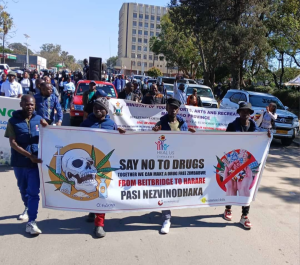 Current government rehabilitation funding is pegged at under ZWG 50 million for the financial year. Health economists and addiction specialists who spoke to Daily Rush were consistent in their assessment. That figure does not come close to meeting the scale of the problem.
To put it in context: the Chitungwiza centre alone requires sustained funding for counsellors, medication-assisted treatment, and aftercare programmes. Multiply that across the high-density suburbs of Harare, Bulawayo, and Gweru, where guka and edibles are most concentrated, and the ZWG 50 million figure looks less like a budget and more like a placeholder.
The Ministry of Health and Child Care has not published a national prevalence estimate for crystal meth use. That absence of data is itself a policy failure. You cannot fund a response to a crisis you have not measured.
What Recovering Addicts Say Parliament Is Missing
Daily Rush spent time at the Chitungwiza rehabilitation centre this week. Three recovering addicts agreed to speak, all requesting anonymity. Their accounts pointed to the same gap: there is almost nothing between the street and the rehabilitation centre. No community-level early intervention. No school-based awareness that young people described as credible. No structured support for families trying to help a member before the crisis becomes acute.
One man, 26 years old and three months into his recovery from guka, said he knew his habit was destroying him for a full year before he found any help. He said nobody came to him. He had to fall completely before the system noticed him.
That is the story the parliamentary hearings have not yet told. The rehabilitation centre is the last line. Parliament is debating the law. Nobody is funding the middle ground.
What Needs to Change
Specialists consulted by Daily Rush identified three interventions that evidence supports and that Zimbabwe’s system currently lacks.
A national drug prevalence survey. Zimbabwe cannot design a funded response without knowing the real scale of use. ZIMSTAT has the methodology. The Ministry of Health has the mandate. The survey has not happened. It needs to.
Community-level early intervention programmes. School counsellors, trained community health workers, and village health workers are already embedded in the communities where guka and edibles are spreading. Giving them substance abuse training and referral pathways costs a fraction of residential rehabilitation and reaches people years earlier.
Dedicated ring-fenced rehabilitation funding. Health budgets in Zimbabwe are routinely raided to cover other shortfalls. Rehabilitation funding, already thin, is especially vulnerable. A protected budget line, accountable to Parliament, is the minimum structural fix.
The Question Parliament Has to Answer
The committee’s hearings conclude this week. A report is expected before the end of the parliamentary term. Daily Rush will report on its findings and whether the recommendations translate into funded action or another shelf document.
The real question is not whether cannabis edibles should be regulated or whether guka should be classified differently. Those are legal questions with legal answers. The harder question is whether Zimbabwe is willing to fund the human infrastructure that turns a law into a life saved. That answer has not yet been given.
If you or someone you know is struggling with substance abuse, contact the Chitungwiza Rehabilitation Centre or reach out to Daily Rush at [email protected], and we will connect you with support.
Daily Rush will publish the full parliamentary committee report findings as soon as they are released. Last updated: August 7, 2026.